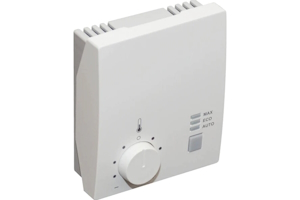
BSK816 HVAC Thermostat
HVAC thermostats are the control hub for HVAC systems, allowing users to set and maintain their desired indoor temperature for optimal comfort and energy efficiency. This guide overviews the distinctions among various thermostat types: line voltage, single and double pole, low-voltage, and technological advancements in manual, programmable, wi-fi, and smart thermostats. This understanding is crucial for selecting a thermostat that enhances home comfort and supports a more sustainable and cost-effective household environment. Line voltage thermostats
Line voltage thermostats operate directly with the electrical system's standard voltage, typically 120 or 240 volts. They are directly wired to the heating units they control.
Operation: These thermostats regulate temperature by interrupting the flow of electricity to the heater. When the room's temperature drops below the set point, the thermostat closes the circuit, allowing electricity to flow and generate heat. Conversely, when the desired temperature is reached, the thermostat opens the circuit, halting the heating process.
Applications: Predominantly found in older homes and apartments, line voltage thermostats are suited for controlling electric baseboards, wall heaters, and convectors. Their straightforward design and direct control mechanism make them a robust choice for single-zone heating systems.
Features: Line voltage thermostats are known for their simplicity and ease of installation. However, they generally lack their low-voltage counterparts' programmability and advanced features.
Single vs double pole line voltage thermostats
A single-pole line voltage thermostat has two interchangeable wires, making it easy to install, and one switch that opens or closes the circuit. However, single-pole thermostats must be constantly powered, even if this means taking power from the heating unit, causing it to periodically shut off or turn on, reducing efficiency.
A double-pole line voltage thermostat needs four wires to install, one of them being an L2 (N) wire. This means the thermostat can be powered even when no power is running to the heating unit, can be turned off, and does not steal any power from the heating unit.
Single pole (top) and double pole (bottom) line voltage circuit diagrams. Load 1 (A), Load 2 (B), thermostat (C), and heating unit (D).
Figure 2: Single pole (top) and double pole (bottom) line voltage circuit diagrams. Load 1 (A), Load 2 (B), thermostat (C), and heating unit (D).
Low-voltage thermostats
Low-voltage thermostats are more advanced than line voltage thermostats. They operate at a safer, reduced voltage, typically 24 to 30 volts. They are the standard for central heating and cooling systems, including furnaces, boilers, air conditioners, and heat pumps.
Operation: Low-voltage thermostats send signals to the furnace or air conditioner to start or stop based on the temperature settings.
Applications: These thermostats are versatile and compatible with various heating and cooling systems. They are mainly used in homes with central HVAC systems, offering precise temperature control across multiple zones.
Features: Low-voltage thermostats have many features, including programmability, Wi-Fi connectivity, and compatibility with smart home systems. This allows for enhanced energy efficiency, remote control, and customization of heating and cooling schedules.